Showing posts with label maine. Show all posts

Friday, August 8, 2014

5 Years at Medomak!

5 years ago I was asked to teach at the New England Fiber Arts Retreat
Joining a few other amazingly talented instructors, whom I LOVE to bits, 
I stepped into this soft embrace that is Medomak.

Here's a wee sampling of the classes I taught this year. 

 Day 1: Foraging For Color


Everytime I teach this class, I am blessed with learning new things. 
Above is Allison from Western Mass who came for her 2nd year. 
From left to right, 
choke cherry, jewel weed, fern, pine needles, moss.
This year, we tried what ever we felt like and had a blast experimenting!

******************************************
Day 2: Rainbows in our Dye Pots


Despite the fact that I forgot my soda ash,
everything worked out and dyed beautifully!
As I was setting up that morning. 
I gave myself the biggest fright when I realized my soda ash never made it off my studio table at home and into my basket. The kitchen very kindly cooked up baking soda for us so that we'd have, in the end, soda ash/ washing soda. The class was saved!

**********************************

Day 3: Shibori and Bundling


Here in this class we just dove into binding and resist making with stones, rubber bands, threads, folding, and plants. Unfolding everything after it had steeped and cured for over 24 hours, was a whole camp event. It was like fire works as we unfolded each piece. Such a fun and free spirited activity. Even for just the on-lookers. Can't wait to do this again. 

***************************************

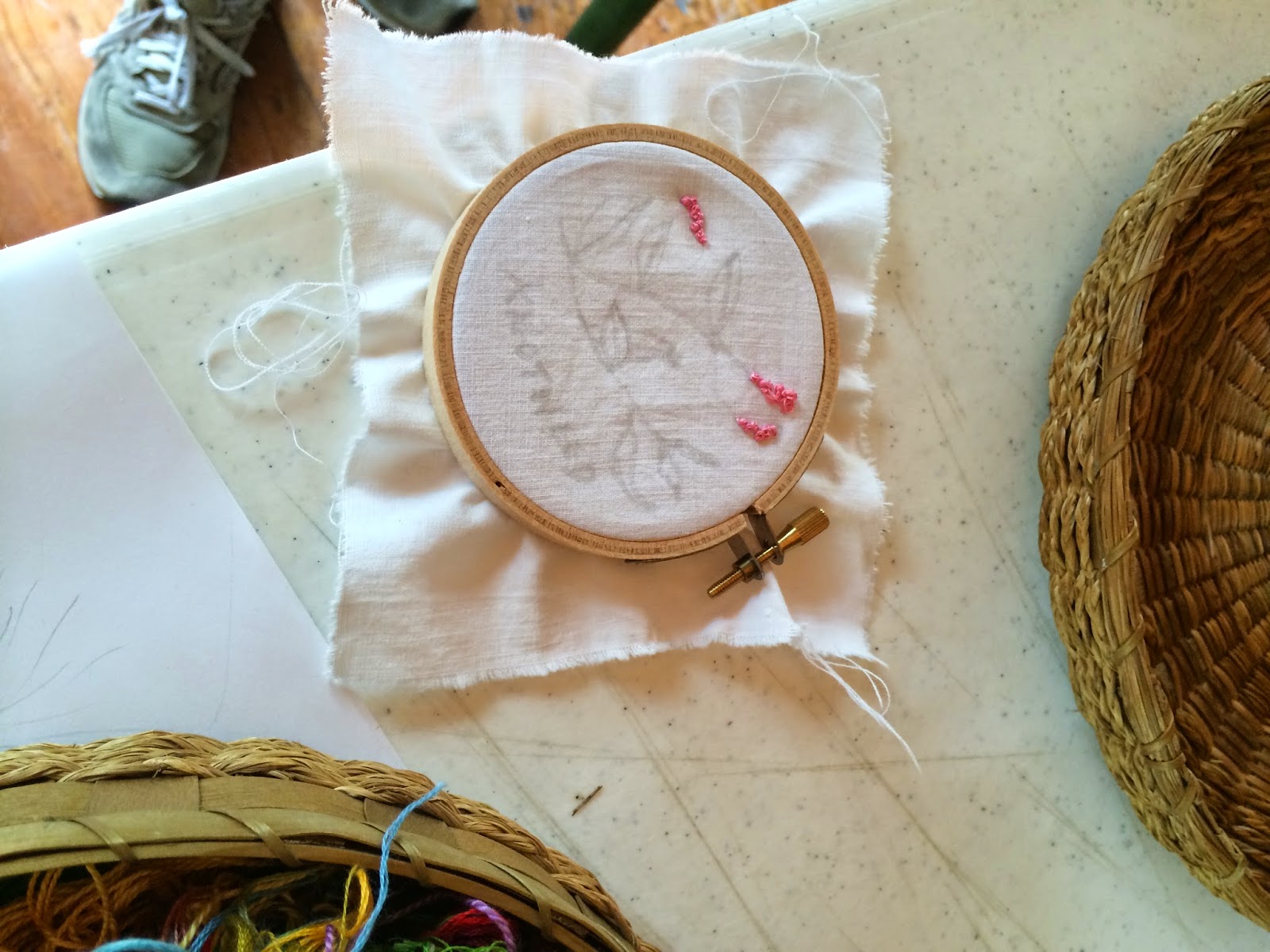
Day 4: Botanical Embroidery


It was a wonderful way to start to wind down the week.
To sit in a quiet group. 
In a quiet space.
And stitch.

That same day we also traveled to Cushing to visit 


These last 3 photos are from previous years as I forgot to take a few more inside this year. 
Silly me. 

Katharine is a wonderful host and always teaches us 2-3 knitting techniques. 
This year, amazingly, she taught us double brioche. I say amazingly beacuse it was also what Bristol Ivy was teaching in one of her knitting classes. We also learned Grecian Lace. 

Visiting Katharine is always such a treasure in the already beautiful week of fiber. 

*****************************

Day 5: Drop Spindle


I always love teaching how to use the drop spindle. 
It's what I used when I taught myself, now 14 years ago.

Give me 1, give me many, I will teach you how to use a drop spindle. The Russian/ Turkish spindle being my perferred choice just because I love how it stores the yarn. If your looking for this style, Casey over at Portfiber carries them. And they are made by Peace Fleece.

When I wasn't teaching, I enjoyed the lake as much as possible
and got some foraging in.

I am afraid this post is a bit one sided though
as there were many other amazing classes going on-
all kind of weaving, 
knitting, 
felting,
carding,
crocheting,
stitching
and spinning.


On the last night, we brought all our projects together. Both finished and in process. And Shared.
I'm always so proud and over joyed to be part of this week with all these amazing and talented people. 
Every year I leave knowing I've made a couple dozen new friends. 


Re-entering the real world was not hard.
But not being surrounded by 30+ fiber crafters, clicking of needles, giggles, and wine was sorely missed. 

However, it had been about 2 weeks since I spent any time with my husband as he was away the week before I left. 

We all clearly missed each other. 
That's Lemon Drop (she was a soft yellow as a chick) on Jubal's shoulder
Tulip and Olive staying close by. 

In the few days that followed, I checked on my fermenting jars
that held tiger lilies, mint and then a yellow bell pepper I added to the group. 


Finished up my pygora fiber on the drop spindle


and then orgainzed the painting studio.


Till next year Fiber Lovies!!
oxox

Monday, July 14, 2014

Peaks Island Plant Dye Workshop Series; Summer 2014

{It's a cutting it a little close} 
But- this Saturday marks the beginning of 
my plant dye workshop series here on Peaks Island!
Just 2 miles out in the Casco Bay from Portland, Maine. 
Ferries run about every hour and it's very easy to get to. 

Join me in my back yard with my chickens and dye pots 
for some dyeing adventures. 
My home and outdoor workshop is just a 5 minute walk from the ferry so no car is needed. 

In each workshop, materials will be provided,
you'll receive 5 hours of instruction
and enjoy a delicious organic home cooked meal from one of my favorite recipes
which we'll enjoy on my porch with a breezy view of the water.
And you'll come away with a ton of skills, knowledge, dyed samples, 
and a full belly.

For further questions or to reserve your spot for any of the workshops
send me an email at:
44clovers@gmail.com
and I'll send you further info including directions and info about the ferry. 

First up:

:: Under the Rainbow :: 
Saturday July 19th
10:30am-4:30pm
{ferry from portland-9:15am. ferry from peaks- 5pm}

Plant dying for the true blue beginner. We’ll learn the basics of preparing plant dye pigment powders with safe habits, experiment with color blending, and go over equipment and materials. You’ll come away with a ton of techniques and tricks to apply in your own dyeing. 
Materials and delicious home-cooked lunch included. 
$125


*********************************************************

:: Mermaid Threads :: 
Sunday August 10th, 
10:30am-4:30pm
{ferry from portland-9:15am. ferry from peaks- 5pm}

Plant dyeing for fabric and garments. Bring 3-4 white/ light colored natural fiber garments or fabric bits. We’ll use a variety of plant dyes like indigo, madder root, onion skins, and a few others to add new life to your pieces! We’ll go over equipment, safe practices, where you can purchase dye materials, and how to care for your newly dyed pieces.
Dyes and a delicious home-cooked lunch included. 
$125


************************************************************

:: Foraging for Color :: 
Sunday August 31st 
10:30am-4:30pm 
{ferry from portland-9:15am. ferry from peaks- 5pm}

Have you ever looked at a plant and wondered if a dye lived inside? I’ll get you jump started into the world of exploring your back yard and neighborhood for dyes. We’ll go over foraging within an ecological context, cook up test pots, go over handy equipment, and talk about safety habits. 
Materials and a delicious home-cooked lunch included.
$125


***************************************************

:: Lichen Magic:: 
Sunday September 7th 
10:30am-4:30pm
{ferry from portland-9:15am. ferry from peaks- 5pm}
  
 Lichens have been used for their dye properties for thousands of years. The colors that can come from lichens cover the rainbow spectrum! You’ll come away knowing at least 4 different types of dye lichens, a few good reference books to use, pigment testing methods, extraction methods, respectful collection methods, the 3 dye-prep methods, and even a little lichenology.
Materials and a delicious home-cooked lunch included.
$125 


Do email me if you have any questions about these workshops.
Hope to see you there!

ox, rachel

Tuesday, February 18, 2014

Peaks Island Fiber Arts Camp 2014

This New Year, for me has begun with thinking about cultivating innovative ways that reach further into the realm of both independent and collaborative creative endeavors to bring my love of fiber, plant dyes, and teaching into new territories.

Over here on Peaks Island, there is a really talented Textile Artist who also works with plant dyes and creates beautiful felted cloth. I've had the wonderful pleasure of getting to know Laura and we spend a lot of time talking about textiles and drinking tea. I'm really grateful for her friendship. She's also the co-fonder of the Peaks Island Fiber Arts Camp that she has been running with her friend, Susan Hanley, for a decade now, also a fellow islander and textile artist.

Several weeks ago, I asked Laura if they might need any help this year. As it turned out, Susan had just let her know she'd like to take a sabbatical for 1 year. So, for this year, I have the pleasure of stepping in for Susan. Laura and I got down to it and have worked really hard meeting about every week to create these 4 camp offerings for children ages 6-14.

Enrollment is now open.

 :: Early Summer Days :: 
whittling, creature making and mud oven granola baking

Spend the early days of summer relaxing with 
new friends and a project or two. We’ll whittle
a walking stick and knitting needles - visit
beaches and share stories. We’ll make a 
piece of fabric from which little animals & 
creatures will grow. And we’ll heat up the mud 
oven and bake delicious homemade granola. 
June 23-27, 8:30-2:30 ages 7-12, $285

**********************************************
:: Fabric Collage ::
Matisse, wool, silk, and collage 

Create a beautiful light and colorful collage. 
Using Matisse’s Cut outs as inspiration 
campers will create their own colors, shapes, 
and patterns with silk cloth. We’ll experiment 
with designs and lay-outs. When all the pieces 
of the collage are ready they will be held 
together, not by sewing, but by felting.
June 30-July 3, 8:30-2:30, ages 8-14, 4 day camp $235

**************************************************

:: Still Life and Lunch ::
drawing, painting, and baking

Fruit salad, bread, blueberry hand pies, pizza and more. 
We’ll spend the first part of each day drawing and painting 
the day’s ingredients. 
Then we’ll work together to prepare
the recipe of the day. 
Finally we’ll enjoy the good food we’ve made. 
On Friday we’ll sew together a book 
of our drawings and paintings 
and possibly include our recipes.
July 21-25, 8:30-2:30 ages 6-14, $285

************************************************

:: Bugs, Tracks, and Crafts ::
explore, inspect, and stitch

Follow the paths of snails, bumbles, and hermit crabs 
while we explore the beach, garden, and forest 
for these tiny creatures. 
We’ll inspect their tracks, habitats, and nests. 
Then using various textile textures, techniques, and our imagination, 
we’ll create unique keepsakes 
capturing the nature of 
these tiny creatures.
August 18-22, 8:30-2:30 ages 6-12, $285

*********************************************
About Laura
“I’ve been making things my whole life - sculptures, clothes, prints, books, and mud ovens. I’m thinking of building a cob cottage someday, but until then I’m busy felting, dyeing and sewing. Each summer I’m glad to share these arts & skills I find so valuable”. 

About Rachel
“Working from my studio here on Peaks Island, I love using oils and watercolors to study botanicals, and foraging wild plants to dye my hand spun yarn. I keep myself busy knitting, sewing, weaving,
felting, blogging and teaching both on island and around New England for my small business, 
44 Clovers”

We're happy to answer any questions:
Rachel (that's me) at: 44clovers@gmail.com
or Laura at: lrglendening@gmail.com

To enroll your child(ren) contact either Laura or myself and we will email you a copy of the brochure where you can print out the registration form to mail in. 

Looking forward to seeing you this summer!


Wednesday, January 8, 2014

Apple Barks; a foraging and dyeing tutorial

I’m very excited and pleased to be starting off the New Year with a weekly foraging and natural dyeing tutorial to share with you. This first post focuses on foraging downed apple limbs from an organic apple orchard here in Maine. Back in October, we took a day trip out to Raven Hill Orchard. I mention the outing here

Using barks from downed limbs is a very easy way to both forage and store until your ready to begin the process. I began the process here. To get the most color out of the barks, they need to soak for at least one week in water. It was October when I began the process, so I left my pots on the porch, though a bit longer than I anticipated. 

A great way to start is to identify what you’ve foraged. If you don’t know, take the time to research it on line or with any nature books you may have around the house. Or ask someone else what they think. Once you know, make a note of what it is. If you have a kitchen scale (which I highly recommend), weigh your foraged materials and make a note of that as well. I’ve tried to remember before- but it never works. I’m so thankful now when I take the time to make these notes. Plus, (i think) it’s really fun to know exactly how much of what you started with. Also, note the location collected and date. Once all this is done, get your barks crumpled into the pots. Cover with water, it doesn’t matter how much, and let soak for at least a week. This long soaking will enable the pigments to be released when heated later, more easily. 

So, I set up my pots outside and then sort of forgot about them. Or rather, every day I thought about them and then got very busy with something else. Exactly two months later, and frozen solid, I couldn’t take the guilt anymore. Mild guilt. And I began the process of dyeing. I did think it pretty neat that they froze solid in the pot. My pots were fine as they are made of stainless steel. My husband kindly brought them inside for me and they thawed. Freezing doesn't do anything different to the materials, other than preserve it. 


I soaked various sample skeins in room temperature water. Actually these weren’t true sample skeins as they were full skeins. A wool alpaca silk blend. 

I placed the two pots on the stove and it wasn’t until after the yarns were soaked through- an hour or more, I added them to the pots. One pot being Hudson Golden Gem and the other being Black Oxford. 

They simmered for roughly two hours. I then turned off the heat and let both pots cool over night into the morning. Then I removed the skeins and hung them over the sink so they could drip. 

I had been soaking 4 other skeins, and added those in the same manner as the day before. I wanted to see what the yarns would pick up from the 1st after bath. I did weigh out each skein but as each one was so light weight, all just under an once, I did not make a note of it. If I had been dyeing a large amount of loose fiber or fabric, I would have written this down. 

After about two hours of simmering (forgot to mention- left the barks swimming free in the bath with the yarns) I then turned off the heat and again let cool over night into morning. Once cooled I hung to dry. 

Here is the fruit itself with the bark. Black Oxford variety. I only processed and dyed using the barks of both apple types. I did not dye with the apples themselves.

Black Oxford barks. The single skein at the top of the picture was from the first dye bath. Dyed over a wool/alpaca/ silk blend. The two skeins on the bottom are actually from the second dye bath (1st after bath). The skein on the left is alpaca/silk blend. The yarn on the right is the same yarn as the top. A slight difference in color. But what a surprising difference with the second blend in that second bath is. Probably the biggest surprise of the whole experiment. 

Here is the Hudson Golden Gem variety. 

Here is the same set up at the first picture. Only difference is the yarn on the left is same as the top, and the yarn on the right is a wool/alpaca blend. All in all, with each skein just a few degrees in color difference. 

And here they are all together. Hudson on the left, oxford on the right. Subtleties... I live for those too. 


When it comes to barks, you do not need a mordant such as alum to make the pigment stay as barks have tanins which is like a natural mordant. Same as in lichens, teas, and coffees. You could certainly experiment with mordants for color variations. This is something I enjoyed about the barks as it’s so simple, one less thing to remember, and except for always needing to be mindful around heat, relatively safe. Also, if cooking dye stuffs in your home, always think about proper ventilation. I keep my oven hood fan on high and when able (like not during a rare polar vortex) I crack the kitchen window. 

For those of you who are really into the science aspect of dyeing, you may find this article interesting. I wanted to enter a link for tanins and found this. Here is another very interesting link - tanins as ink. I'll be combing over these shortly.

I am endlessly fascinated with huge groupings of plant life that hold pigments. Lichens, flowers, tree leaves, tree barks, and mushrooms. And then there are bugs and shellfish...

If you have any questions regarding this post, natural dyeing, or would like to share what you foraged and cooked up, I'd love to hear from you, leave a comment below:)

Wishing you all warmth and light during this polar vortex.

ox, r